

Architectural Studies #01
Observations for a new aesthetic.

As I work on my New Aesthetics grant project, I’m sharing my observations — in pictures and words — in “Architectural Studies” posts like this one. You can read the project description here:

The New Aesthetics grant I received was just mentioned by Ross Douthat in The New York Times in “The New A.I. Money Should Be Spent on Beauty.” He admonishes tech titans to emulate the industrialist and philanthropist Andrew Carnegie:
Take a lesson from your Gilded Age predecessors, and treat beauty as a central charitable pursuit. Build monuments, statues, museums, universities, cathedrals, public gardens — and yes, even mansions for yourselves. Leave a physical legacy to future generations, not just a record of programs and disbursements. Recognize that meaning inheres in architecture, art and landscape as much as in more measurable goods. …
I know of at least one tech founder, Stripe’s Patrick Collison, who is putting money into the search for new aesthetic schools. My advice to others who want to follow his example is to take a Waymo from your tech HQ or frontier A.I. lab over to the Palace of Fine Arts in San Francisco, part of the Panama-Pacific International Exposition in 1915, which was funded partially by public money, but partially by that era’s gilded rich. Like other such expositions, most of the buildings were dismantled, but the Palace was beloved and endured, with a later reconstruction enabling its permanence.
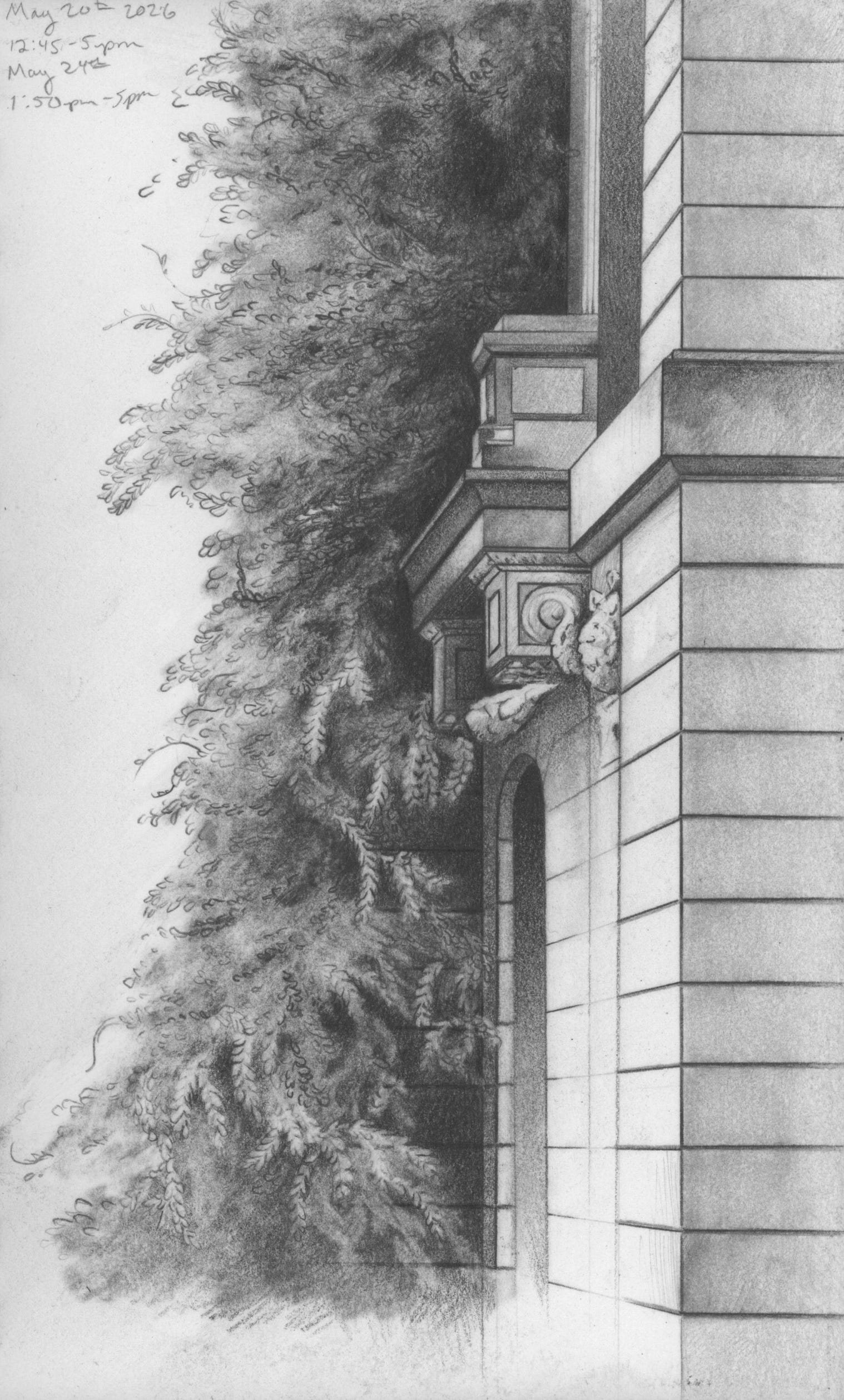
It seems fitting that I was sketching the wisteria cascading off Carnegie Mansion when Douthat’s op-ed came out. While planning travel to make architectural studies, I’m doing warm-up drawings at home in New York. It’s been raining, so I started to sketch from inside the café in the Cooper Hewitt Museum, which is in Carnegie Mansion on the Upper East Side, about a ten minute walk from my apartment — the two large columns of wisteria consuming the back of Carnegie Mansion are one of the most beautiful features of my neighborhood.
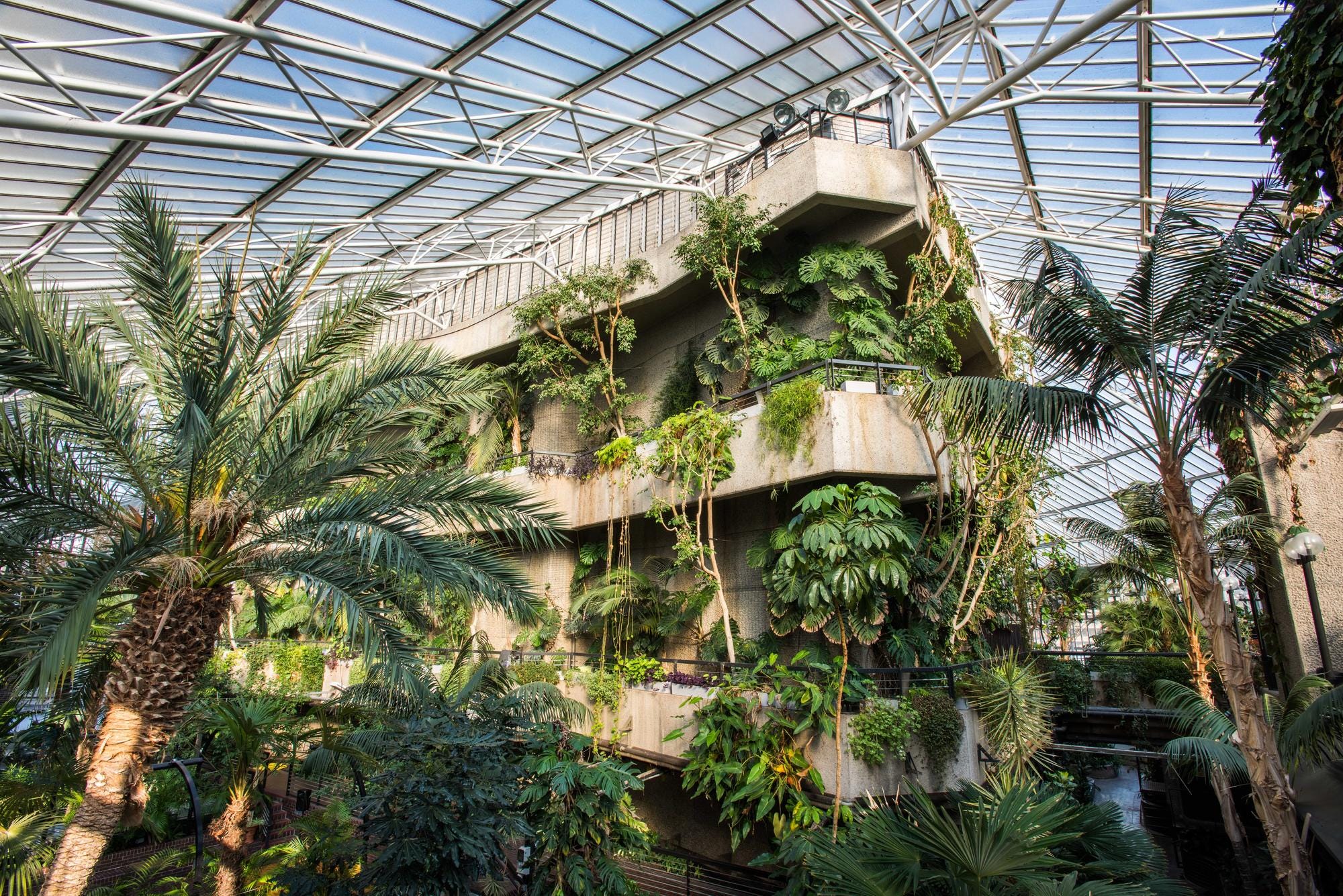
The interaction between foliage and architecture obviously impacts how we experience buildings, but out of all the architectural styles, this may be most true for Brutalism. Plants elevate and soften the austere, rectilinear concrete. A quintessential example is the Barbican Conservatory in London, a garden encased in concrete and glass. When buildings become oversized concrete planters, Brutalism seems less brutal. Memes about the style were trending recently, and I thought this one nailed it:


When Brady Corbet’s The Brutalist came out, I wrote a film review as an excuse to comment on the architectural style. Though I dislike Brutalism, I still see the qualities that make some love it: the plants, of course, but also the play of light on quiet surfaces, and the expressive potential of materials like concrete that can be molded into countless shapes. Under the Brutalist design of the Washington, D.C. metro stations, for example, a chiaroscuro pattern of light and shadow creates a magnificent arch over the tracks. So the style has redeeming qualities, but it has always seemed to me that lovers of Brutalism suffer from the bigotry of low expectations, forgiving too much ugliness. I want to steal the good qualities from Brutalism and discard the rest.

My first trip funded by my New Aesthetics grant will be to London on June 1, where my main goal will be to spend time in the Barbican Conservatory and on the estate grounds. I also want to visit less celebrated Brutalist landmarks like Trellick Tower (designed by Ernő Goldfinger, whose architecture was so loathed by Ian Fleming that he named a Bond villain after him). In between challenging myself with disagreeable architecture, I hope to spend time with more ornate buildings, too — perhaps the Victorian greenhouses in Kew Gardens will balance my time spent in the Barbican Conservatory.
Given that my goal is to invent a new style of ornamental architecture, it may seem strange that my first trip is to visit unadorned Brutalism. The choice is partly practical — I have a free place to stay right now, so this trip is low-hanging fruit — but I also think concrete has a lot of underexplored ornamental potential, given how easily and inexpensively it can be molded. If we want more beautiful industrial buildings, then affordable and fast ornamental options might convince companies to invest more in aesthetics. When I consider how we can make the notorious data centers beautiful, for example, my imagination turns to the ornamental potential of concrete.


I love the discipline of spending time with a style you dislike in order to sharpen your taste!
I like your thinking. I'm one of the people who say, "I don't know much about art (or architecture) but I know what I like" and I've been thinking since you started this, what exactly DO I like? This is my chance to chip in and help shape the New Style For The 21st Century, I've been complaining for years that I hate ultra modern office buildings, I should propose an alternative.
So okay, I realized that I don't like ultra-modern brutalist large buildings because they are too stark, but I do like ultra modern single family homes that are surrounded by beautiful gardens, because all the greenery contrasts wonderfully with the stark lines of the homes. So I don't think brutalism needs to be tossed into the dustbin of history, it just needs to SHRINK to the point that it is in scale with its surroundings. NO BRUTALIST BUILDING MORE THAN TWENTY FIVE FEET TALL!
I was thinking that, for larger buildings, classical and neoclassical are very nice. Those styles combine simplicity with enough graceful curves and ornaments to prevent viewers from shuddering in dismay at the ugliness.
I want two kinds of neighborhoods - In the first kind of neighborhood, each home is incredibly individual - a Tudor timbered house next door to an ultra modern house next door to a hobbit house built with a round door and round windows. In the second kind of neighborhood, a single unifying style knits the neighborhood together and the neighborhood has public gardens and a neighborhood shopping center designed in a style that coordinates with the houses. All houses are mid-fifties ranch homes, or all houses are Georgian, or all houses are log cabins. Then everyone can pick the kind of neighborhood they like - architectural harmony or architectural variety.
Personally I want to live in a hobbit hole. There actually was a style for this, I think mostly on the West Coast in the 1930's and 1940's, I think, it was called Storybook Style. Here ya go, a link to a sampling of Storybook Houses!
https://buildgreennh.com/storybook-style-homes/