

Towards a New Aesthetic
What I'll do with my New Aesthetics grant.

At the end of last year, Patrick Collison and Tyler Cowen put out “A Call for New Aesthetics”:
We, Patrick and Tyler, have differing views of the artistic merits of Bauhaus, but we are both very impressed by the movement’s success: they sought to define an aesthetic for the twentieth century, and basically did. Bauhaus obviously sits as part of broader tides—functionalism, constructivism, De Stijl, etc.—but the project also shows how intentional artistic ambition can succeed. Everything from modern offices to modern tech hardware is in some sense downstream of Bauhaus.
We’re more than a quarter way through the new century and we can now ask: what is the aesthetic of the twenty-first century? Which are the important secessionist movements of today? Which will be the most important great works? Today, futuristic aesthetics often mean retrofuturistic aesthetics. So, what should the future actually look like?
There will not be singular answers to these, but we are very interested in attempts to answer the questions. In particular, we would like to fund some artists who are thinking about them.
And now I’m delighted to announce that I was awarded a New Aesthetics grant to try to invent a new ornamental style of architecture. I’m going to do this through drawing, because just as writing is thinking, drawing is imagining. You might invent something new when you sit down to solve the problem of what your version of a thing should look like.


I bemoaned the loss of ornamental architecture1 in “‘America was supposed to be Art Deco’” and then expanded my ideas in “Beauty Under the Cover of Darkness,” in which I allege that the architects who denounced ornament succeeded through the power of drawing — emphatically not through the power of their actual buildings.
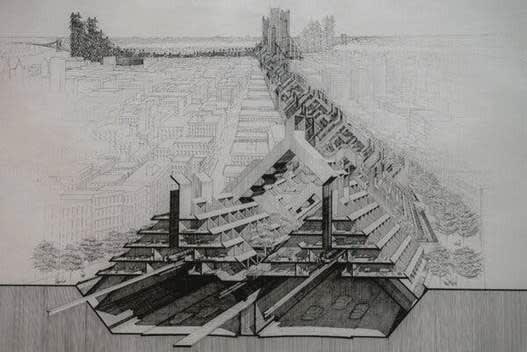
Le Corbusier was the primary popularizer of modernist architecture, because his drawings stole the hearts of the next generation of architects. His mentees, like Gordon Bunshaft, gushed over his drawings while calling his buildings “the shabbiest goddamn thing you ever saw.” Some of the most celebrated architects influenced by Le Corbusier, like Michael Graves, also focused more on drawing than building. (Tom Wolfe pokes fun at architects winning awards for drawing without building much in Bauhaus to Our House.) My personal favorites are the drawings of Paul Rudolph, which I find stunning, but they were in service of ghastly ideas like demolishing parts of Manhattan to build an expressway.
Drawings, and the other visual arts, have the power to turn ugliness into beauty. When Claude Monet painted his impression of a sunrise, he transformed the industrial haze obscuring the port of Le Havre into a dream. Francisco Goya made a series of stunning etches about abuse, corruption, and murder that art critic Robert Hughes described as making “eloquent and morally urgent art out of human disaster.” Consider how the only time you’re happy to see flies land on fruit is within a still life.
It pains me that my own artform was the murder weapon. But if Le Corbusier could use drawing to kill ornamental architecture, then I can use drawing to resurrect it.
If Le Corbusier could use drawing to kill ornamental architecture, then I can use drawing to resurrect it.
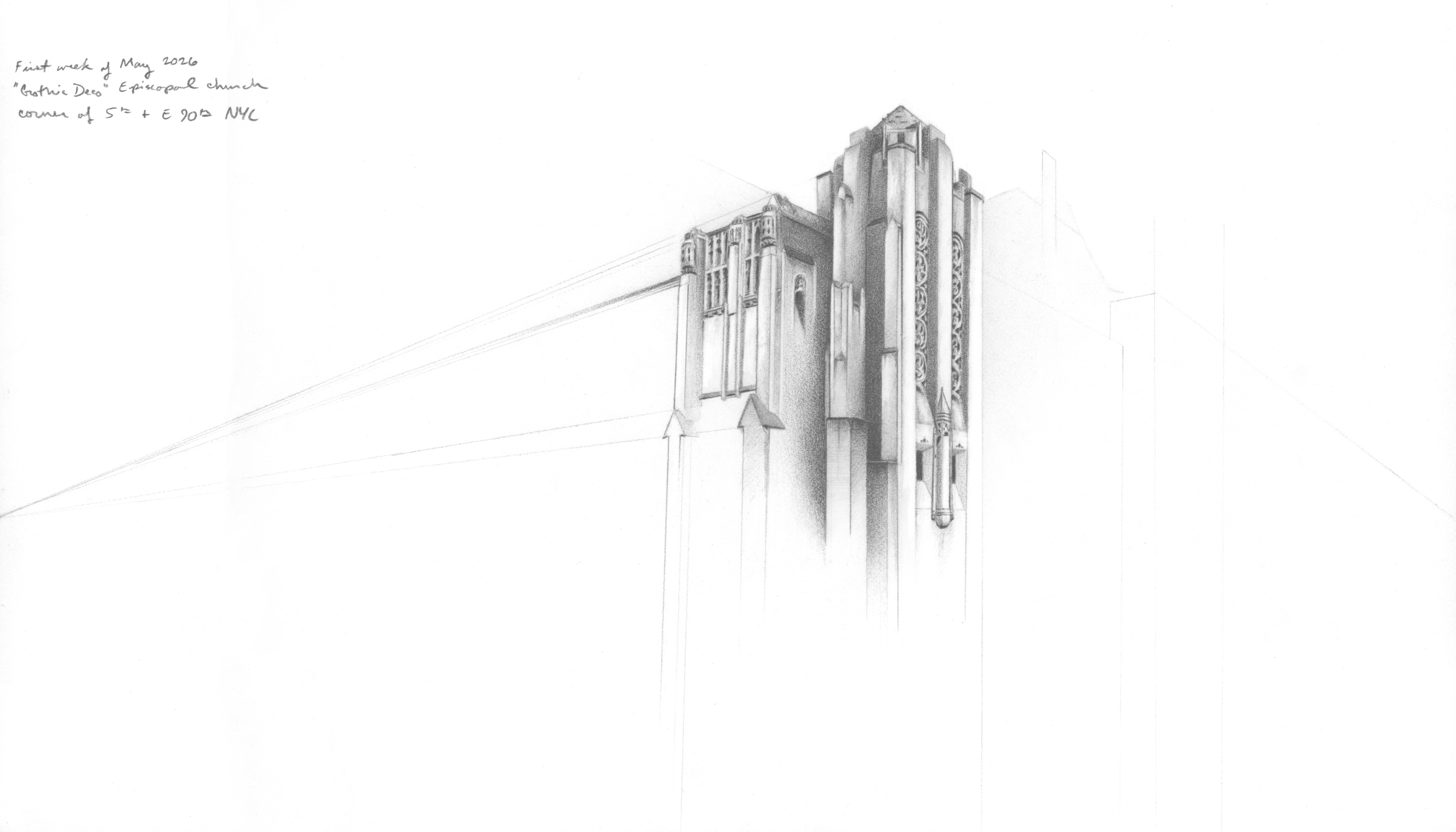
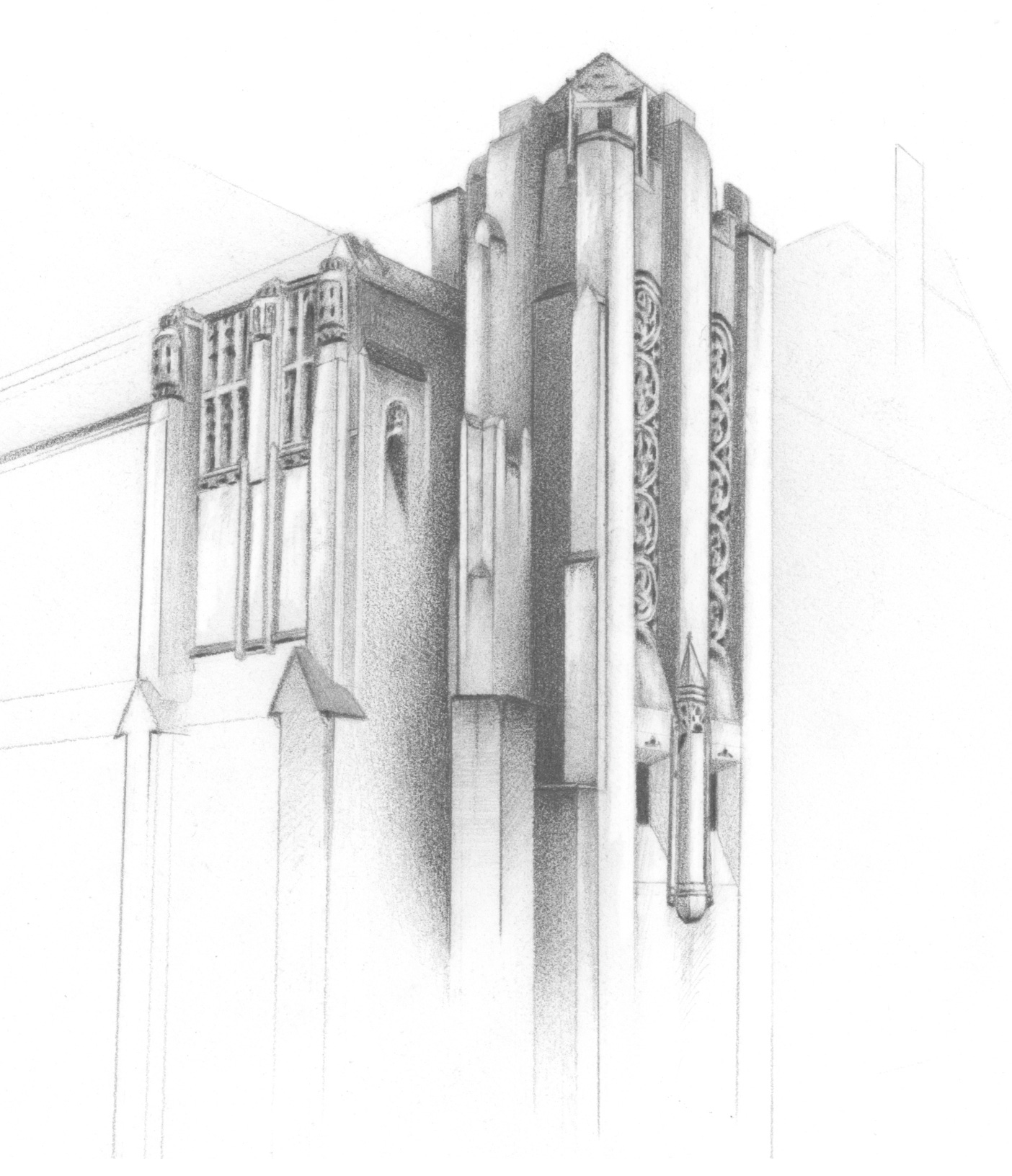
As I wrote in “The Power of Art in the AI Age,” artists have always synthesized the past to create novelty. I’ve gotten to spend a lot of time with great architecture — but not enough, so I’m going to use the New Aesthetics grant to travel to places I haven’t gotten to yet. I’ll start by targeting cities with Art Deco and Brutalist architecture — one of my favorite styles, and one I’ve written about with scorn. I’ll make sketches of the architecture while I’m there in person, like this study of a “Gothic Deco” Episcopalian church in my neighborhood. I like how the towers grow like crystals.
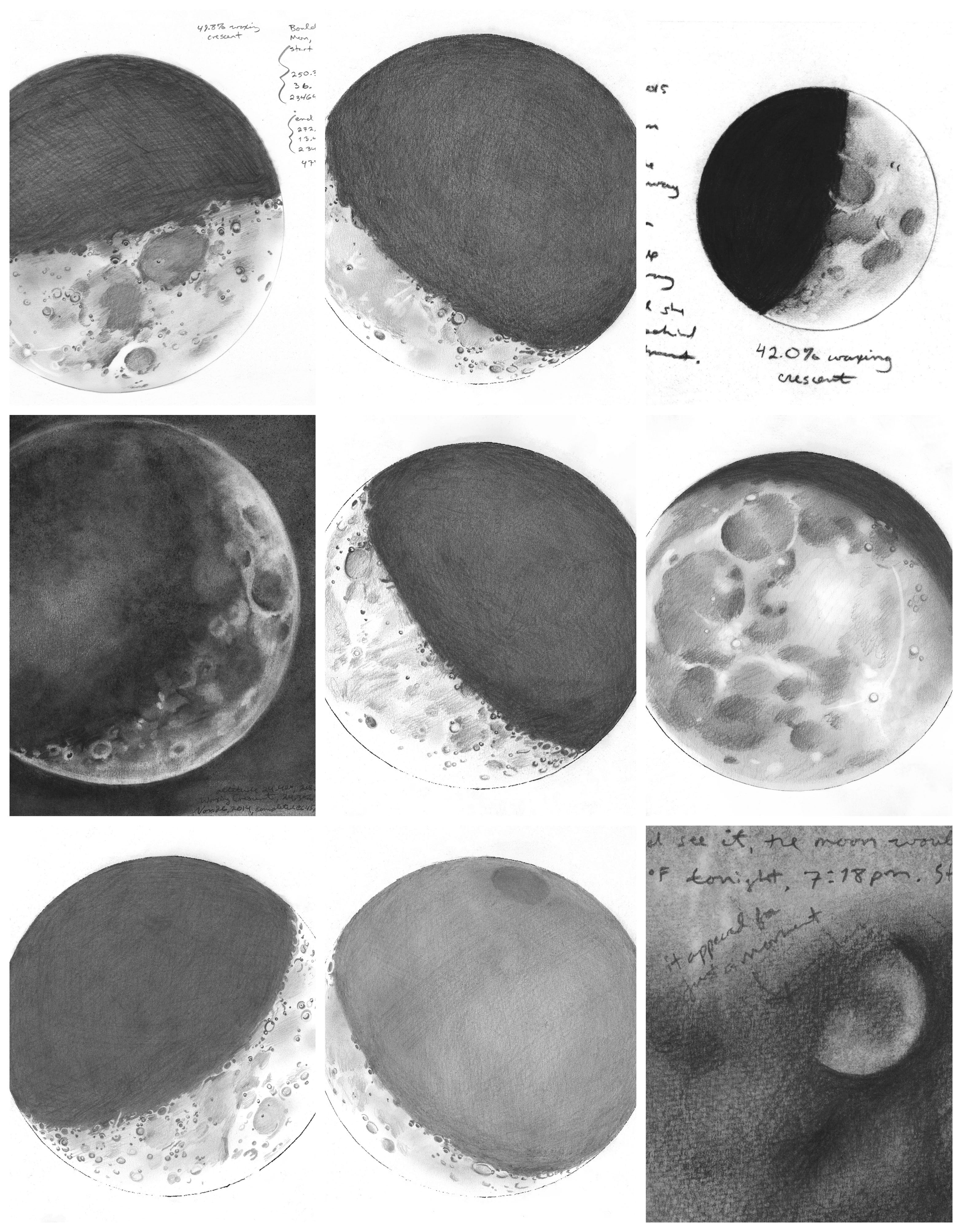
Drawing from life, rather than a photo, teaches you unexpected lessons. In “Learning How To See The Moon,” I described how drawing the moon every night for six months gave me an intuitive sense of its orbit:
All of us are accustomed to the phases of the waxing and waning moon, with its variety of crescent-shapes. But not everyone notices that the moon also rises in the sky nearly an hour later each night. Because the Earth is spinning on its axis, twirling around its center like a ballerina on pointed toe, our view of the sky changes as the planet beneath our feet points us in different directions. That is why both the moon and sun appear to rise in the east and set in the west, as this visual effect is caused by the direction of the Earth’s rotation. Imagine if the ballerina decided to twirl left instead of right, and how that would make the room appear to her in the opposite order.
At the same time, the moon is orbiting around the Earth, so that when our planet spins us ’round to see it again each night, we have to rotate a bit longer to catch up with the moving moon. It’s as if the room around the ballerina was also slowly rotating in the same direction as her, so that as she twirls, it takes her a moment longer to face the same side of the room again. For those six months of nightly drawing, this meant that my routines and sleep also chased after the moon, syncing the rhythm of my life to its cycle, as I became more or less nocturnal depending on where the moon was in its orbit.
Trying to visualize celestial movements can feel mind-boggling — the moon is a spinning orb circling a larger spinning orb, hurtling together around a rotating fireball that drags them all in a giant loop around an unfathomable hole in the center of our galaxy — but as my own body fell into step with the moon’s orbit, tracking its motion became more intuitive. Upon embarking on this project, I expected to learn the details of the moon’s face by drawing its portrait over and over again, but I had not anticipated how my observations would help me develop a more accurate mental model of our moving solar system. Prolonged observation teaches us how to see, so that until we have looked hard, we cannot know what we have hitherto been blind towards.
The grant will afford me an analogous experience with architecture. Anticipating the unknown unknowns I’ll discover while drawing is the most thrilling part of this opportunity. I wonder how my body will feel in these new places — and I remember what it was like the first time I turned the corner and saw Il Duomo looming over me in Florence, and when I stepped inside the temple in Nara where the massive Buddha gave me the same sensation of experiencing an optical illusion, as if these structures were too big to be real.
I’ll share my sketches, research, and observations here on Fashionably Late Takes as I travel. In upcoming posts, I’ll pair drawing studies with what I’m learning about architecture. And while stewing in my influences, I’ll try to invent something new.
Ornamentation is often conflated with old. There’s no reason why someone cannot come up with a new style, but there seems to be a wide-spread, baked-in assumption that we’re out of aesthetic ideas. When Americans debate what new buildings should look like, the terms are typically framed as a choice between modernism and traditional European styles.
Recent examples include Noah Smith writing a piece titled “Will Americans want more housing if it looks prettier?” but then only considering European pastiche for what pretty buildings might look like, because of “the kinds of building styles that intellectuals often yearn for.” Or Matthew Yglesias writing “Stop blaming ugly buildings for the housing crisis” but only discussing modernism versus “traditional styles” or “neoclassical.” Smith expresses support for deregulation that would allow developers to experiment with ornamentation and alternative styles, and Yglesias worries that “something new” inevitably results in avant-garde despised by the masses, but they don’t seriously consider the possibility of something both beautiful and new.
Although even if we’re pessimistic about the likelihood of new aesthetics, and stick to discussing historical styles, they could have considered how Americans would react to a pastiche of, say, Art Deco, which the French began but Americans perfected about a century ago. Smith complains that “If you plunk down old-looking European-style buildings in the middle of Houston or Seattle, people tend to ridicule them as cheesy and inauthentic.” This is irrelevant, because we have our own aesthetic history to plunder, without trying to ape Europe.
This is a wonderful project!
I love your thesis about drawings being the thing (that flipped the switch). It's so hard to pinpoint the thing, most likely because it was several things. Drawings could explain the initial appeal. And indeed in the age before computers drawings were what stirred imaginations. I would even suggest that maybe not just Le Corbusier's. I remember reading comics from the prewar period, most notably Flash Gordon, and being stunned by the streamlined cities. They were quite Art Deco-ish, but even more futuristic -- cleaner lines, elegant shapes, not a lot of ornament. It is even possible that such comics had a greater influence than Corbusier, and that young architects were just looking for a champion of what they already intuitively wanted to build -- streamlined futuristic cities. Maybe I am overfitting the evidence, I'm just sceptical that a few guys could have caused it all, and could have spread it everywhere so rapidly, had the conditions not been ripe for it.
Drawings alone can't explain the continued appeal. Other forces (fashion, conformity, ideology) must have taken over later on to sustain the ugliness to this day. (Of course, those forces are not enough to explain the ascent of ugliness, for if everyone was just conformist to the established figures the drastic change would not have happened in the first place.)
Several thoughts, in brainstorming fashion, on to how to fix this mess.
If we look back to why the drawings were so appealing, a big part of it is their sculptural quality. Architectural drawings tend to be black-white-grey so they lend themselves to emphasizing form. They are always zoomed out to a distance at which the building is a sculpture -- distance from which people do not actually experience it. Secondly, the buildings are made of "renderium", the smooth material that does not age.
So one avenue to investigate is to artificially limit oneself to 1) closeups only and 2) weathered materials only (as if buildings start from being old).
Such constraints should be if anything liberating -- the best architecture was produced when it was constrained by technology and money, and the worst now when technology can do wonders and money is abundant.
Any new ornamental style will probably have to involve sculptures of people and animals. Looking back Art Deco sculpture has a certain pattern to it, but it's a tall order to try to invent a sculptural style -- they certainly didn't think they were doing it back then. It became obvious only afterwards.
So just by legalizing/normalizing sculpture again we are on good path to a new architectural style (that will again be obvious and named only in retrospect -- that's a given). New (and resurrected old) patterns of adding sculptures to facades should be a top priority.
Also, more texture seems better and there doesn't seem to be an upper bound to that. Quite literally even a facade that is simply corrugated is better than one that is flat, and one that is twice as corrugated is better than the simply corrugated one. So a return to lines and carvings on facades is probably another avenue where progress can and should to be made.
Ultimately, architecture has always been an imitation of other architecture. So the new style has to be modular and fractal, so that it can be imitated and "stolen" in small portions as well as wholesale. Even a small detail like color tends to be imitated -- in Zagreb Croatia most new buildings are white-grey-black, be they large or small, public or private. It's very hard to figure out why exactly this has happened, but it must be a reflection of the wider international trend of losing color. The point here being that even such a small thing is imitated.
A window style that always has a sculpture as part of the window? Can be copied. Especially if the sculpture is slightly functional too (in a gimmicky way is fine). We need better door framing too, that can be copied.
Line patterns that can be applied to facades once again. They need a "why" too. Not necessarily a logical why, but some sort of invented reason attached.
Some consideration should be made for materials, but not too much. "Honesty" and "true to the material being used" are just empty phrases of people who have no other guidance. Once a style spreads, materials will be chosen accordingly.
Architecture is about fashions. So it starts with ideas (stories) first, not materials first or money first.
Best of luck and I will follow the progress! :-)
BEAUTIFUL WORK MEGAN, congratulations.