

Architectural Studies #03
Observations for a new aesthetic.

As I work on my New Aesthetics grant project, I’m sharing my observations — in pictures and words — in “Architectural Studies” posts like this one. You can read the project description here:

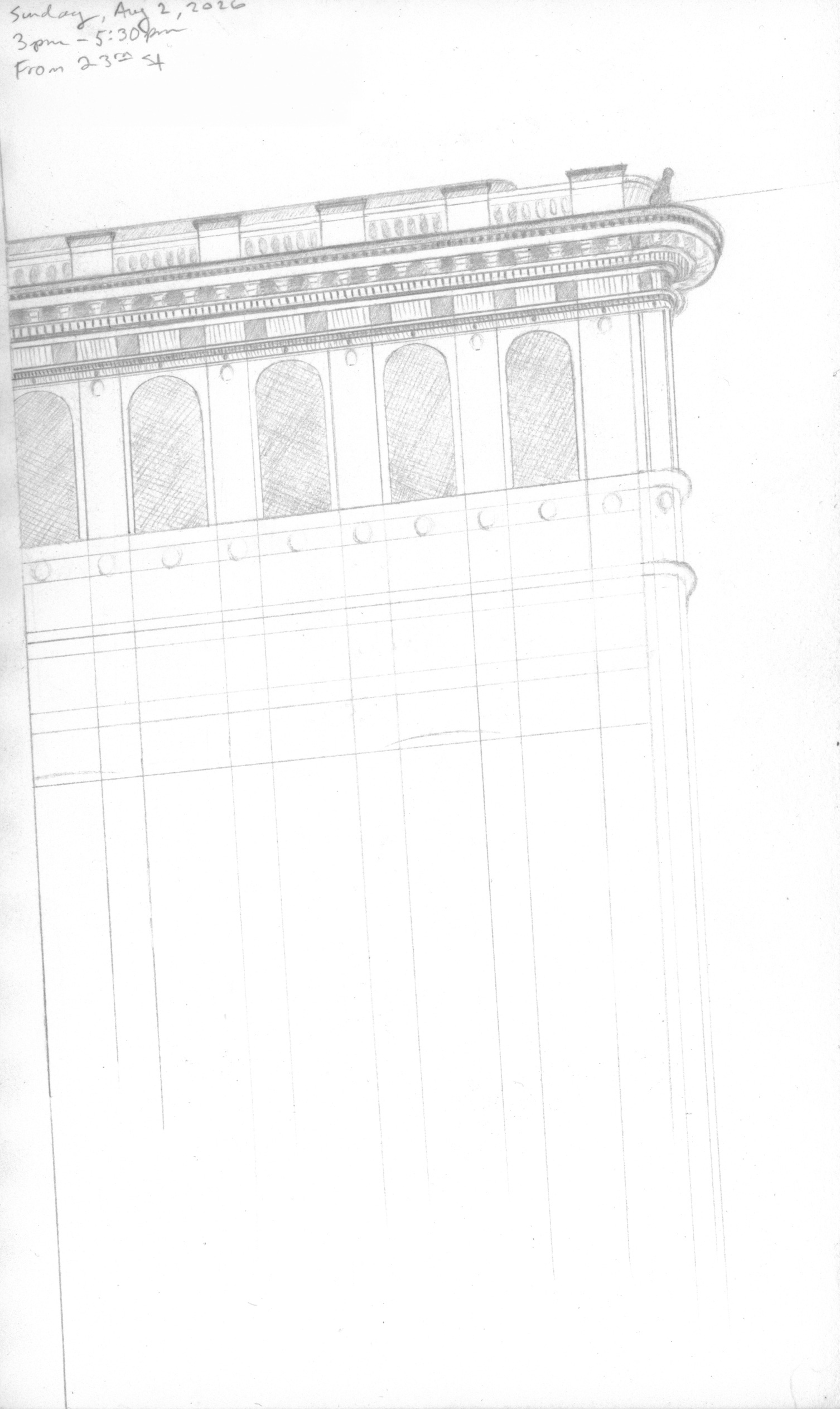
Scaffolding that has shrouded the Flatiron Building for several years has begun to come down, and now only the base remains hidden from view. Built in 1902 as a commercial building, the Beaux-Arts skyscraper is reopening this fall as a condominium. It’s one of the most recognizable buildings in New York City, and the only one that gave its name to the surrounding area: the Flatiron District.
I spent a couple hours last weekend lightly sketching out the basic layout of the facade as seen from a park bench on 23rd Street, and I’ll return soon to finish the drawing. The design is organized like a classical column with three tiers of distinct ornamental layers. At the turn of the 20th century, when architects in Chicago were first inventing the skyscraper, they frequently invoked such comparisons to theorize about their designs. It was a famous Chicago architect of that era, Daniel Burnham, who designed the Flatiron Building. His rival Louis Sullivan, known as the father of skyscrapers, was critical of both the Beaux-Arts style that Burnham championed and the classical column design theory.
Sullivan wanted the new type of building to have a distinct and new ornamental aesthetic. He accused Burnham of becoming overly dependent on classicism, displaying a lack of originality that Sullivan believed would damage architectural aesthetics for at least half a century. In his influential 1896 essay “The tall office building artistically considered,” Sullivan listed several design metaphors of which he disapproved that were favored by his colleagues — the beauty of prime numbers, the nature of a logical statement, the vertical and organic growth of trees — alongside the classical column:
Certain critics, and very thoughtful ones, have advanced the theory that the true prototype of the tall office building is the classical column, consisting of base, shaft and capital,—the molded base of the column typical of the lower stories of our building, the plain or fluted shaft suggesting the monotonous, uninterrupted series of office-tiers, and the capital the completing power and luxuriance of the attic.
Sullivan argued that no design metaphor could explain how a skyscraper should look. Rather, he believed that the purpose of the building should determine its aesthetic. In that essay, he coined a phrase that later Modernist architects would embrace passionately: form follows function. The function of a skyscraper is not the same as the function of a classical column, so Sullivan argues that column design is a poor theory of why a skyscraper should have three tiers of distinct ornamental layers:
It is the pervading law of all things organic and inorganic, of all things physical and metaphysical, of all things human and all things superhuman, of all true manifestations of the head, of the heart, of the soul, that the life is recognizable in its expression, that form ever follows function. This is the law. …
Does this not readily, clearly, and conclusively show that the lower one or two stories will take on a special character suited to the special needs, that the tiers of typical offices, having the same unchanging function, shall continue in the same unchanging form, and that as to the attic, specific and conclusive as it is in its very nature, its function shall equally be so in force, in significance, in continuity, in conclusiveness of outward expression? From this results, naturally, spontaneously, unwittingly, a three-part division,—not from any theory, symbol, or fancied logic.
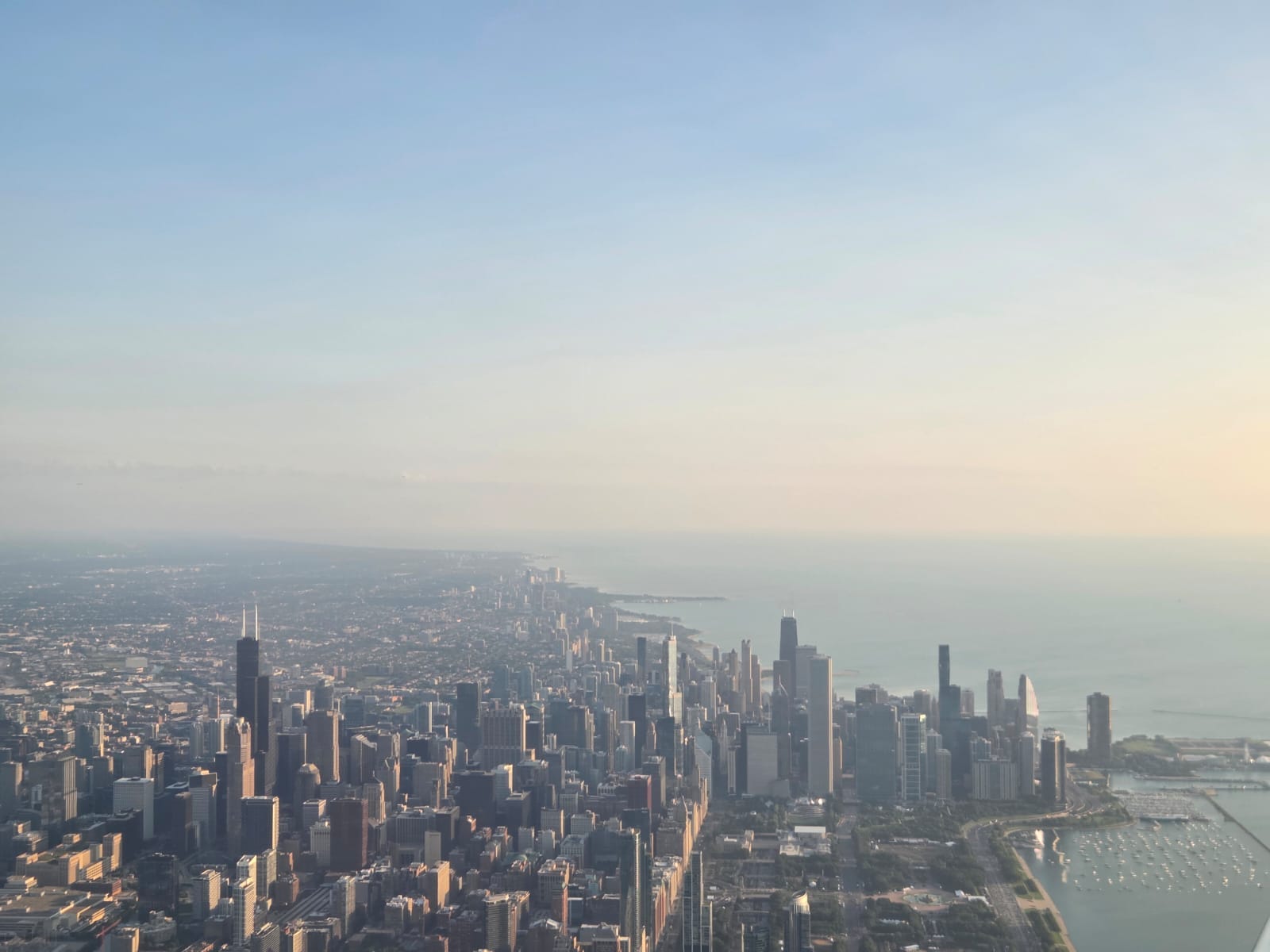
I admire both of these Chicago architects, and as I draw the Flatiron Building, I enjoy reflecting on their clash of opinions about skyscraper aesthetics. It’s fitting that as I write this, I’m flying into Chicago for a layover on my way to Miami, where I’ll spend the next week drawing the Art Deco on South Beach. Soon I’ll come back for a proper Chicago drawing trip, too.
My next architectural study post will be about South Beach Art Deco, but I’ll return to the Flatiron Building to finish this drawing and share more thoughts about it soon.
The first time I saw that building in person it stopped me cold