

Fate leads the willing and drags the unwilling
Reflections on determinism and free will.

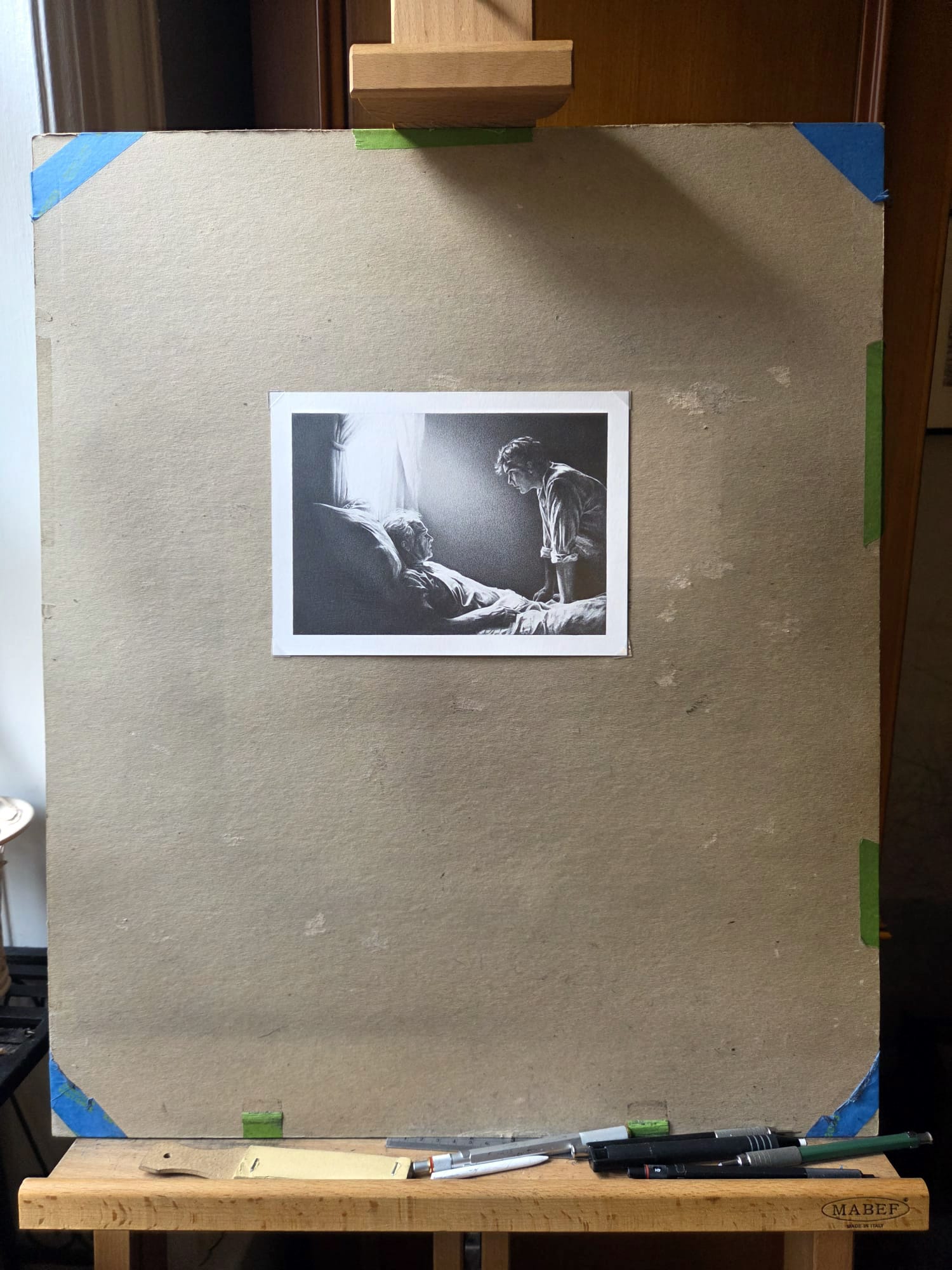
“Fata volentem ducunt, nolentem trahunt.”
(“Fate leads the willing and drags the unwilling.”)
— Seneca, quoting Cleanthes in his Letters to Lucilius (Letter 107)
In my latest Quillette piece “On Truth and Beauty” I used John Steinbeck's East of Eden as an example of how art can “work” regardless of whether its central theme turns out to be true. In the case of that novel, the central theme is that we are not doomed to any fate, that we can choose who to become. My essay was also a response to another Quillette piece by biologist Jerry Coyne, who — unbeknownst to me at the time — frequently engages with the topic of determinism and free will.
I’ve long been familiar with determinism: the claim that our universe has been unfolding according to natural laws in a chain of cause and effect going back to the beginning of time, from which our minds are not immune, so that our experience of willpower is but an illusion we evolved to feel as we act out our fate. But I’ve never worried about it, because people still argue about the nature of reality, and physicists have yet to fully grasp its fundamental laws, and consciousness remains a mystery, so that it has always seemed to me that there is enough room for doubt to avoid an existential crisis. And in any case, even if we do live in a deterministic universe, then the illusion of free will is too strong to change our behavior, and the very pretension of choosing to change would be absurd.
Lately I’ve lapsed in my modus operandi of just not thinking about it. I’ve been carefully reading Coyne’s argument that free will is an illusion. And I’ve been wondering if I have an inescapable fate.
Most philosophers nowadays are “compatibilists” who claim to acknowledge the reality of determinism while maintaining that it is somehow still compatible with free will. This is nonsensical to me. Such philosophers seem to be playing semantic games to redefine free will into something less profound than genuine agency.
Compatibilism is not the same as operating within constraints, or within a narrow band of options. There are different flavors, but broadly, compatibilists claim that even if all of our desires are causally determined, we can still call those desires “free” so long as we genuinely want them, sans coercion, regardless of the fact that we were fated to have those desires and could not have chosen otherwise. And regardless of the fact that coercion would then be outside the control of the coercer just as much as the coerced.
Contra this attempt at contorting the concept of free will, Coyne writes that he adheres to biochemist Anthony Cashmore’s definition:
… I believe that free will is better defined as a belief that there is a component to biological behavior that is something more than the unavoidable consequences of the genetic and environmental history of the individual and the possible stochastic laws of nature.
Then Coyne elaborates:
In this definition there’s a “will” that doesn’t involve physical processes but can alter decisions. Another way of saying this is the way most people understand free will: “If you could replay the tape of life and return to a moment of decision at which everything—every molecule—was in exactly the same position, you have free will if you could have decided differently—and that decision was up to you.” This in turn can be condensed to the view that “you could have done other than what you did.” This concept is called “libertarian free will” or “contra-causal free will.”
I agree with Coyne and Cashmore that this is the only reasonable definition. But I don't want to rehash arguments about compatibilism here — you can read Coyne’s recent debate with Michael Shermer for that. To me, the only relevant question is whether learning more about the nature of reality would strengthen the case for free will.
It isn't obvious to me that there's a compelling counterargument to determinism. At least since the ancient Greeks, people have wondered how agency could be possible in a world reliably governed by cause and effect.1 The philosopher Epicurus conjectured that atoms sometimes “swerve,” thereby injecting enough uncertainty into the laws of nature to make free will possible after all.
But as Cashmore points out, “even if the properties of matter are confirmed to be inherently stochastic, although this may remove the bugbear of determinism, it would do little to support the notion of free will: I cannot be held responsible for my genes and my environment; similarly, I can hardly be held responsible for any stochastic process that may influence my behavior!” In this scenario, atomic randomness rules the vagaries of fate. The causal chain would no longer be theoretically predictable, but the effects would remain outside of our control.
Amor Fati

Physics may try its damnedest to instill in us existential dread at an incomprehensible universe, but biology will always be the most offensive science. For physics merely deals with the nature of reality, whereas biology contends with our own nature, and so it repeatedly runs up against wishful thinking about who we are. Biology forms the parameters of our fate, and fate treats us harshly.
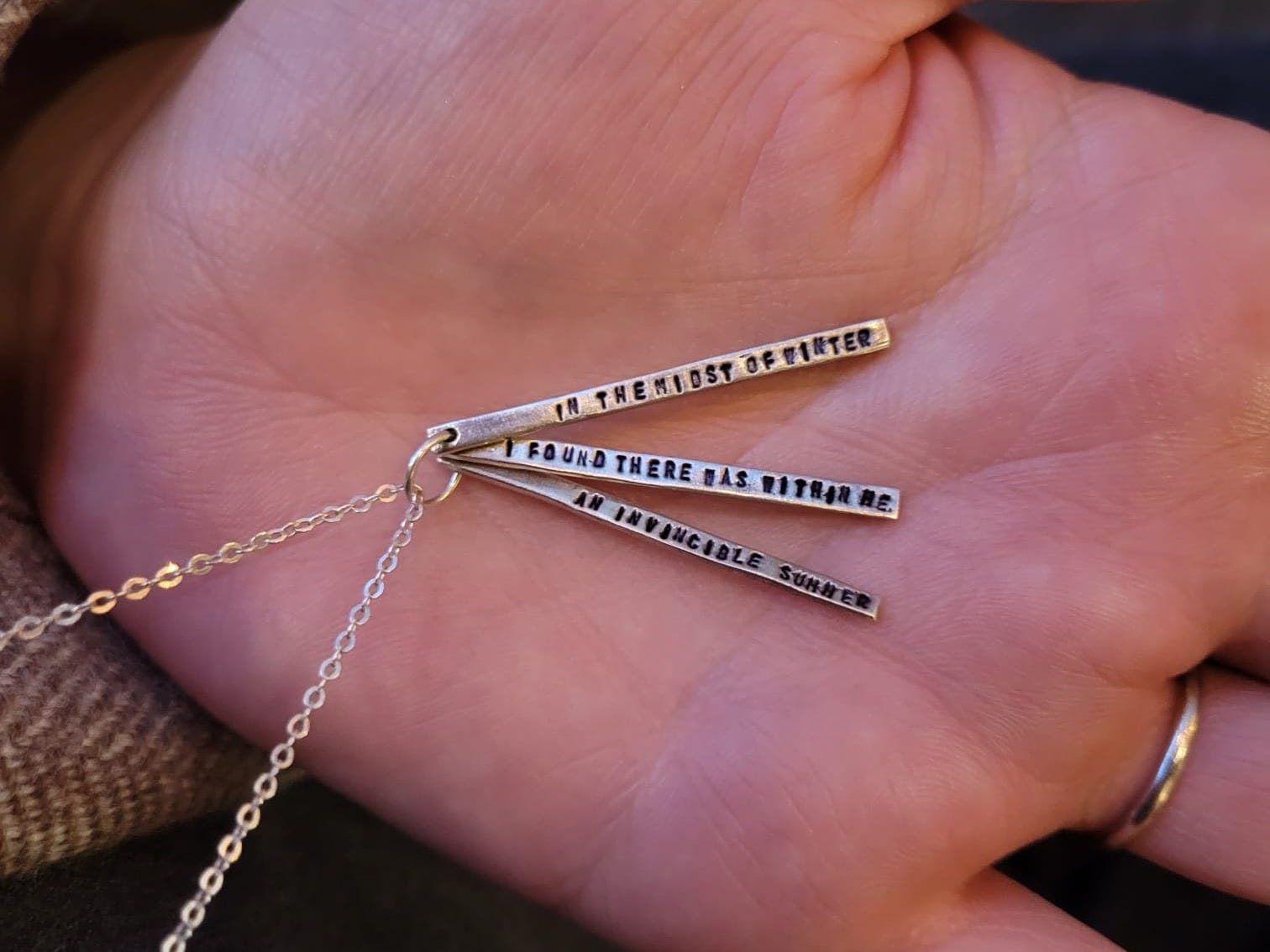
Nearly every day I wear a necklace bearing a quote from Albert Camus: “In the midst of winter, I found there was, within me, an invincible summer.” It soothes me to fiddle with it constantly. If determinism is correct, then it may be my fate to have an invincible summer within me, but it’s troubling to consider that the opposite may just as well be true, and that someday my internal summer could wither away. I want to believe that under any circumstance, I can choose to muster strength. This isn’t about getting credit for being a strong person, but rather believing that resilience is within my control, so that nothing and no one can undermine me.
Similarly, I’ve often drawn strength from the example of Viktor Frankl, who persevered through extreme atrocity. By safeguarding his soul from the Holocaust, Frankl demonstrated that it is humanely possible to remain resilient no matter our condition:
We who lived in concentration camps can remember the men who walked through the huts comforting others, giving away their last piece of bread. They may have been few in number, but they offer sufficient proof that everything can be taken from a man but one thing: the last of the human freedoms — to choose one’s attitude in any given set of circumstances, to choose one’s own way.
Hard determinists like Coyne would contend that the ancient chain of cause and effect simply resulted in some humans who could hack it, and others who could not. That Frankl is still admirable, for what he was, much as we admire the majesty of other natural phenomena without attributing agency. We can stand in awe of Frankl just as we stand in awe of the Alps.
Having a fate doesn't bother me as much if I'm fated for greatness. I have no false modesty. If fate is real, then I couldn't take pride in my fortitude, but I would be inherently great through and through. Inevitably great. Irrevocably great.
In the Cashmore paper that turned Coyne into a determinist, Cashmore concludes:
The beauty of the mind of man has nothing to do with free will or any unique hold that biology has on select laws of physics or chemistry. This beauty lies in the complexity of the chemistry and cell biology of the brain, which enables a select few of us to compose like Mozart and Verdi, and the rest of us to appreciate listening to these compositions. The reality is, not only do we have no more free will than a fly or a bacterium, in actuality we have no more free will than a bowl of sugar. The laws of nature are uniform throughout, and these laws do not accommodate the concept of free will.
But I don't want to be someone who only appreciates great art. I want to be someone who creates it, whether through my own volition or because it is my destiny. I want to experience an existence that is maximally interesting. I want my one, short life to be sublime. Whether greatness is achieved through merit, or is an intrinsic and inescapable quality of my being, matters less to me than the outcome I covet.
Arrogant? Probably. But I pity the artist who would settle for anything less.
Though I observe in myself that fate only bothers me if I am fated for mediocrity, I also see the inconsistencies in my point of view. For even if I have free will, then it is surely limited by so many factors outside my control — my genes and environment, the behavior of other people, sheer luck — that my determination alone could never be enough to secure my dreams. Even so, the feeling that I can do something about it, of being empowered at all, brings me (a perhaps illogical) comfort.
We can stand in awe of Frankl just as we stand in awe of the Alps.
One of my favorite philosophers, Immanuel Kant, abhorred and rejected the ideas of determinists like Baruch Spinoza. For Kant, human dignity was predicated on freedom. He believed that if Spinoza was right, then humanity is naught but a “turnspit” lacking moral value.
Kant’s philosophy helped form the foundation of the humanistic worldview undergirding classical liberalism, alongside other Enlightenment thinkers like John Locke, who asserted that man is “naturally free, equal, and independent.” This is the fundamental claim of the American experiment I cherish. Determinism does not necessarily undermine liberalism, if we are fated to insist on it, but taking determinism seriously does provoke me to wonder about the philosophical justifications for liberalism in a universe where dignity cannot be based on freedom.

I return, as ever, to Camus. He admonished us to imagine Sisyphus happy. Zeus punished Sisyphus by condemning him to push a boulder up a mountain, only for it to always roll back down to the foothills just before he reached the peak, where Sisyphus must descend to repeat his task for eternity. Camus found triumph within the tragedy:
But it is tragic only at the rare moments when it becomes conscious. Sisyphus, proletarian of the gods, powerless and rebellious, knows the whole extent of his wretched condition: it is what he thinks of during his descent. The lucidity that was to constitute his torture at the same time crowns his victory. There is no fate that cannot be surmounted by scorn.
My understanding of Camus’ version of the myth is that the gods tried to take everything from Sisyphus, but one thing lay beyond their reach: his consciousness. They wanted him to suffer, but he does not agree to suffer. Sisyphus scorned the gods by choosing happiness instead.
But a hard determinist must go further and acknowledge that even our outlook is part of the causal chain going back to the beginning of time. That some of us are not merely condemned to mediocrity, but to degradation and wretchedness. Fated to be pathetic. Fated to wallow. Fated to despair.
If determinism is correct, then it is unavoidable that some of us are simply damned. So it chills my heart to take determinism seriously. And I fiddle with my necklace, but it brings me a little less solace than before.
Can no theory of physics rescue freedom? In The Fabric of Reality, physicist David Deutsch points out that the threat to free will is actually more fundamental than the chain of cause and effect going back to the beginning of time. In classical physics, it is not just free will that is an illusion, but our experience of time itself. The concept of “cause and effect” is actually meaningless in spacetime, where past, present, and future exist simultaneously:
In spacetime, something happens to me at each particular moment in my future. Even if what will happen is unpredictable, it is already there, on the appropriate cross-section of spacetime. It makes no sense to speak of my ‘changing’ what is on that cross-section. Spacetime does not change, therefore one cannot, within spacetime physics, conceive of causes, effects, the openness of the future or free will. …
Consider this typical statement referring to free will: ‘After careful thought I chose to do X; I could have chosen otherwise; it was the right decision; I am good at making such decisions.’ In any classical world-picture this statement is pure gibberish.
But then Deutsch says that none of this matters, “because spacetime physics is false.” He insists that we must instead use quantum mechanics to explain the fabric of reality, and that this does not merely inject randomness. Quantum mechanics, according to Deutsch, suggests the existence of a multiverse — he believes this multiverse is compatible with freedom.
Though the passage of time is still an illusion in Deutsch’s multiverse, he restores meaning to cause and effect. It is sensical to say “event X” causes “event Y” to happen, if throughout the entire multiverse, Y reliably happens in universes where X took place, and rarely where X is absent. Conventional statements about free will, which classical physics had seemed to render absurd, are represented literally as the consequence of understanding free will as a distribution across the multiverse:
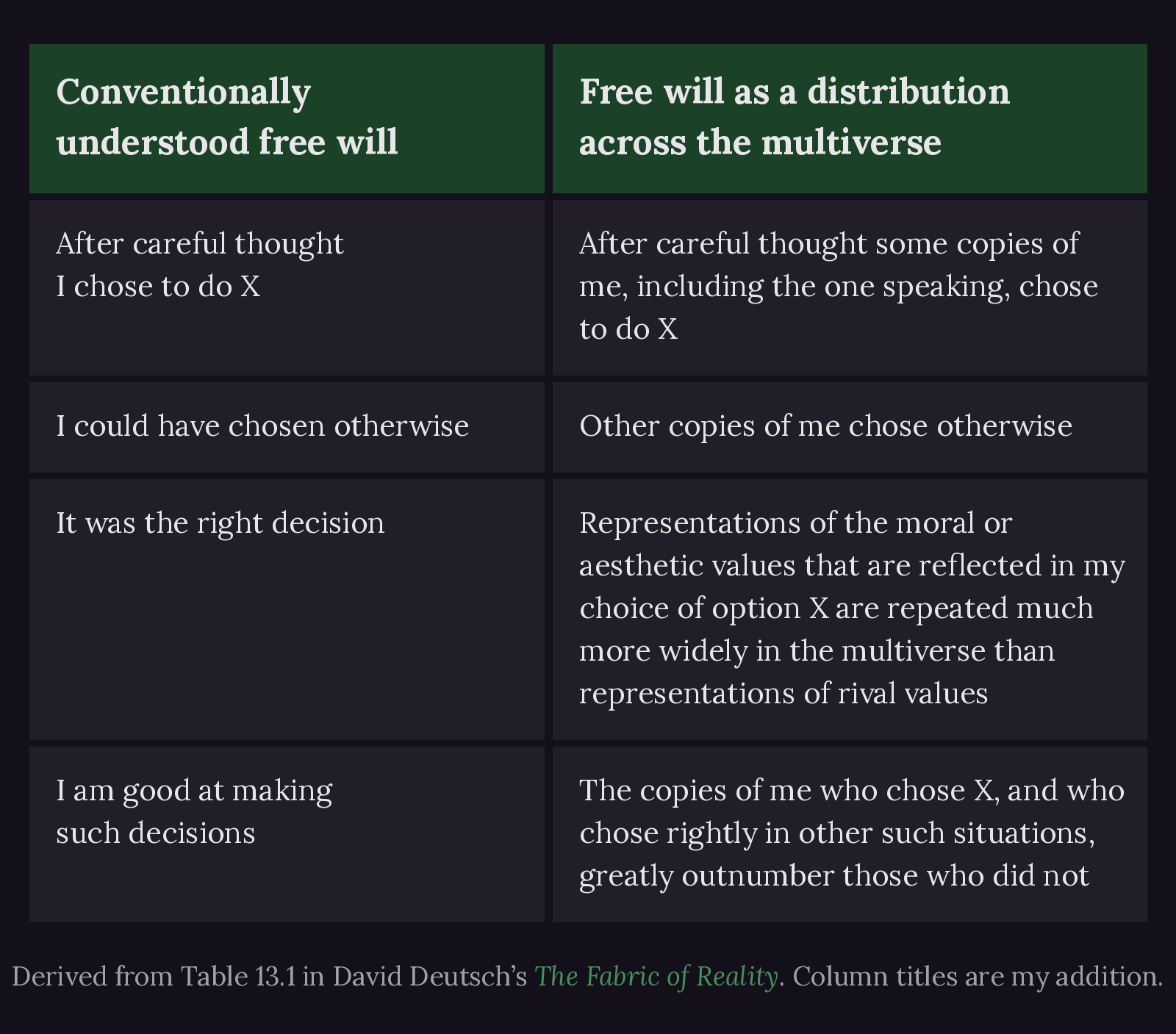
Because an individual’s variations and near identical copies share the same tendencies, most versions of an individual tend to make similar decisions. Taken together, the infinite versions of an individual’s choices emerge as a probability distribution across the many worlds. And because our choices affect the distribution of possible universes, the existence of human minds means that the multiverse is not random — that, for Deutsch, amounts to agency.
Even so, Deutsch’s multiverse presents a new tragedy. It would mean that there are infinite versions of me suffering every injury and injustice I thought I had narrowly escaped. When I tell the story of my car accident, for example, I emphasize that 90% of similar injuries require amputation — how lucky I am, that I was one of the 10% who got to keep her leg!
But doesn’t the existence of a multiverse suggest that most versions of me became amputees? How many multitudes of me died that night? I remember the icy nausea that accompanied the thought “I nearly died.” In a multiverse, that would be the sickening realization that an incalculable number of “me” really did just die. It would mean that every kind of agony that it is possible for me to suffer, some version of me suffers; the opposite is also true, of course, but that does not negate the tragedy.
I've just assumed it's far beyond my pay grade. Similar to Augustine's thoughts on God. "That which you know is not God. If you think you understand , you have failed". I have far more mundane concerns to occupy my time.
If you've not seen this take on Sisyphus
https://vimeo.com/23083554
You might enjoy this article that argues causality does not imply determinism:
https://newideal.aynrand.org/is-free-will-magic/